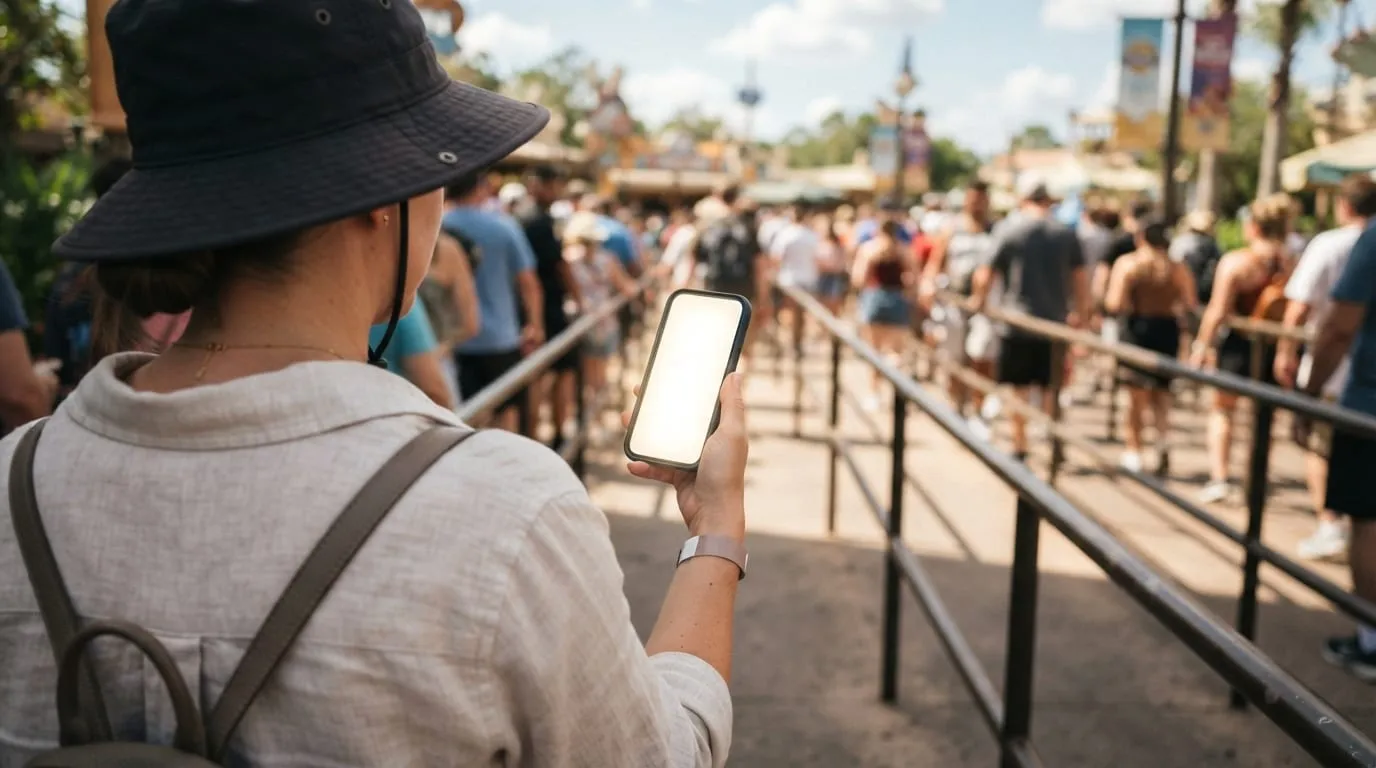
Worth It?
Is Lightning Lane worth it at Disney World?
It is not Universal Express. It is a booking system you operate from 7am until closing, and that is the part nobody prices in when they buy it.
Orlando Lovers verdict
Is Lightning Lane worth it at Disney World?
- Great for — peak season, one-day visits, and anyone with two or three rides they refuse to miss
- Think twice if — you are visiting in September or early May, or you are happy to be at the gate before opening
- Value — roughly $15-$35 per person per day, plus $10-$25 for individual headline rides
- Time saved — 1 to 2 hours a day, and only if you use it well
Lightning Lane is Disney’s paid queue-skip, and the most useful thing to understand about it is what it is not.
It is not Universal Express. Express is a pass you carry: you walk up to almost any ride, all day, without thinking. Lightning Lane is a booking system. You get one ride at a time, in a window, and the moment you use it you are back on your phone booking the next one.
That is the real price, and it does not appear on the receipt. The money is modest. The attention is not.
The short version
Used properly, Lightning Lane returns one to two hours on a busy day. Used casually — booking three things in the morning and then forgetting about it until the afternoon — it returns about 40 minutes and you have paid full price for it.
It rewards people who plan and punishes people who improvise. If that sentence made you tired, that is useful information about whether to buy it.
Disney sells you a shorter queue. What it charges you is a whole day of low-grade admin.
What it actually costs
There are two separate products, and buying only one of them is a common and expensive mistake.
| Product | Price | What you get |
|---|---|---|
| Multi-ride pass | $15-$35 per person, per day | A rolling series of shorter queues across most attractions in the park |
| Individual rides | $10-$25 per ride, per person | One booked window on a headline attraction sold outside the pass, up to two a day |
The multi-ride price swings with park and date. Magic Kingdom and Hollywood Studios sit at the top; Animal Kingdom and Epcot sit lower, because they need it less. A family of four on a busy Hollywood Studios day, buying the pass plus one individual ride each, is looking at roughly $200 to $240 for the day.
Disney also sells a much more expensive all-attraction version on limited dates, priced well into three figures per person per day. It is the closest thing to Universal Express that Disney offers, and it is priced accordingly.
Why the split matters
The rides Disney holds back from the multi-ride pass are, by design, the ones you came for. That is the whole logic of the split: the pass covers the middle of the menu, and the headline attraction is sold to you again.
So the honest way to budget is not “the pass costs $29”. It is “the pass costs $29 and the ride I actually care about costs another $20”. Price it that way and Lightning Lane is roughly half of Universal Express, for meaningfully less convenience.
If it helps to think in outcomes: Express buys you a relaxed day. Lightning Lane buys you three or four specific rides you would otherwise have queued 70 minutes for, and leaves the rest of your day exactly as it was.
How it actually works on the day
Booking opens at 7am. Disney hotel guests can book seven days ahead; everyone else books three days ahead.
You start by choosing your first selections, and from there you add one at a time as you use them. On a busy date at a popular park, the good return windows on the best rides are gone within minutes of 7am. Not hours. Minutes.
Then the day itself is a loop: tap in, ride, open the app, book the next thing, walk toward it. Do that loop well and you will ride eight or nine things by mid-afternoon. Do it lazily and you will ride four.
The difference between those two outcomes is not money. It is whether someone in your group is willing to be the person on their phone.
When it is genuinely worth it
Peak season. Mid-June to mid-August, and roughly 18 December to 2 January, waits on the headline rides routinely pass 75 minutes. That is when an hour and a half back is worth a lot more than $30.
One-day visits. One day gives you no second chance. A single bad queue costs you a fifth of the visit, and you cannot recover it tomorrow because there is no tomorrow. Buy the pass and one individual ride.
Two or three rides you refuse to miss. If there are specific attractions that would sour the trip if you missed them, buy the individual passes for exactly those and consider skipping the multi-ride pass entirely. That is a $20 to $50 decision, not a $240 one, and it is the most underrated way to use the system.
Hollywood Studios and Magic Kingdom. These are the two parks where the ride-to-guest ratio hurts most. Epcot and Animal Kingdom are usually manageable without paying.
When you should skip it
September and early May. The two genuinely quiet windows. Most posted waits sit under 35 minutes and the pass buys you very little. Put the money toward a park day or a decent dinner.
If you rope-drop and mean it. The first ninety minutes after opening are the best free queue-skip in Orlando. A group that is genuinely at the gate before opening, walks straight to the biggest ride, and does two or three headliners before 10.30am has already captured most of what the pass would have given them.
If nobody wants to run the app. This is the real disqualifier. Lightning Lane assumes one person in your party will spend the day watching a booking screen. If nobody wants that job, you will underuse it, and underused it is bad value.
Short attention spans and small children. Toddler pace does not fit booked return windows. You will miss slots because someone needed a snack, and missed slots are money burned.
The part Disney will not say out loud
The phone-in-hand day is a genuine downside of this product, not a quirk of it.
You paid to be in a place designed to be looked at, and the system you bought asks you to look at a screen every twenty minutes instead. On a good day that trade is worth it. On a low-crowd day it is a self-inflicted wound.
We would rather Disney sold a flat, unlimited, more expensive pass and left everyone alone. Until it does, this is the deal on the table.
What it does not fix
It does not cover every attraction — the split is the business model.
It does not shorten the entry queue, the bag check or the walk from the parking tram. Budget 30 minutes from car to gate regardless.
And it does not make a return window flexible. Miss yours and, on a busy day, that is simply gone.
Our verdict
At 7.4, Lightning Lane earns its score on price rather than experience. It costs roughly half what Universal charges and it does genuinely give back an hour or two on the days that need it.
It loses points for the thing it asks of you in return. This is a queue-skip you have to work, and Disney has quietly moved a job that used to be free onto both your credit card and your afternoon.
Buy it for peak dates, one-day visits and rides you refuse to miss. Skip it in September, skip it if you are disciplined at rope drop, and if you are hopping between parks the same day, read our Park Hopper verdict before you stack both add-ons onto one ticket.
Frequently asked questions
How much does Lightning Lane cost at Disney World?
The multi-ride pass runs roughly $15 to $35 per person per day depending on the park and the date, with Magic Kingdom and Hollywood Studios at the top of the range. The biggest rides are sold separately at $10 to $25 each, and you can buy two of those a day.
Is Lightning Lane the same as Universal Express?
No, and the difference matters. Universal Express is unlimited and needs no planning. Lightning Lane gives you one ride at a time in a booked window, and you have to keep rebooking all day. Same idea, very different experience, and Disney is the cheaper of the two.
When should you book Lightning Lane selections?
Booking opens at 7am, seven days ahead if you are staying at a Disney hotel and three days ahead if you are not. The best return windows on the headline rides go within minutes on busy dates, so the difference between booking at 7am and booking at 9am is real.
Is Lightning Lane worth it for a one-day visit?
Usually yes. One day gives you no second chance, so a 90-minute queue costs you a fifth of the visit. Buy the multi-ride pass and add one individual ride for whatever you would be most annoyed to miss, then be ruthless about rebooking.
Do you need Lightning Lane in September?
Rarely. September and the first half of May are the two genuinely quiet windows at Walt Disney World, with most waits sitting under 35 minutes. Arrive at opening, ride the two biggest things first, and the pass buys you very little for the money.
Keep planning
 8.5
8.5 Is Universal Express worth it?
It is the most expensive queue-skip in Orlando and, on the right day, the best money you will spend. On the wrong day it is a $200 souvenir.
Read the full verdict 6.8
6.8 Is the Disney Park Hopper worth it?
Two parks in one day sounds like more holiday for the money. On a short trip it is mostly bus rides. On a long trip it is one of the best add-ons Disney sells.
Read the full verdict
Orlando theme park tickets, decoded
The same ticket can cost $60 more on a Saturday. Here is the plain-language guide to Orlando ticket pricing, add-ons, and where it is safe to buy.
Read the guide